

Interview with Michael Galban.
A Look Back at the Wampum / Otgoä Exhibition
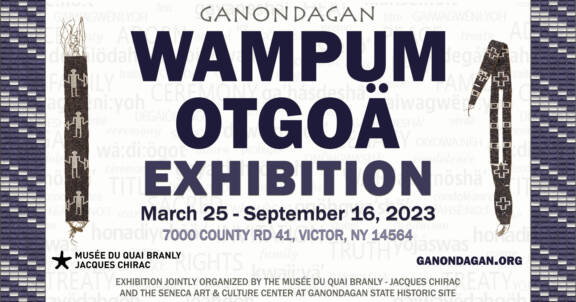
Michael Galban, a curator of the "Wampum / Otgoä" exhibition, an in-depth exploration of the history and culture of wampum, shares his thoughts on the presence of this exhibition at the Seneca Art & Culture Center, and its role in the renewal of intercultural relations between Indigenous nations, Canada and France. Michael will tell us about the diplomatic and spiritual impact of this project, which marked a turning-point for the Center, which he heads.

It has been a while now since we carefully and lovingly packed up the Wampum / Otgoä exhibition and watched it leave for the McCord Stewart Museum in Montreal. We have since opened new exhibitions and defined our plans for future exhibitions over the next six years at the Seneca Art and Culture Center at Ganondagan . There is much to look forward to; however, it is always important to reflect on what we have accomplished and try to gauge the impact and worth of those past projects.
Wampum / Otgoä, firstly, as an international project with France and Canada, was to be the first of its sort ever attempted by a facility in the New York State Office of Parks, Recreation and Historic Preservation agency. While we were aware it was an ambitious and challenging project, its grave importance became clear during the planning and final implementation process, and our resolve and energy to bring the exhibition’s touring to a successful conclusion grew.
By following traditional Haudenosaunee protocols for handling wampum, and extending invitations to other Nations to do the same, we have built strong alliances where before there were none. This process is known as “clearing the road” in traditional rhetoric. It was once an essential aspect of diplomatic relationship-building, which would often be used with allies. “Opening up a road” was a metaphor for creating a clear line of communication. Both parties would take responsibility for maintaining that open road and keeping it clear of obstacles. A collaborative project or exhibition can be regarded as such. Looking back on the mounting of the exhibition I can now clearly see that this is exactly what we did.


“Welcoming the Wampum” was an event reserved for official tribal delegates whose ancestors created some of the exceptional objects coming from the Musée du Quai Branly–Jacques Chirac. It was decided that we would enact an ancient ritual known as “Edge of the Woods” for the day. It was once common for Haudenosaunee people to offer this invocation whenever official visitors arrived, but today it is rare. The concept is simple: by using three strands of sacred wampum beads, the host nation would “wipe away the tears”, “open the ears”, and “clear the throat”. By doing so, the host nation would metaphorically remove the things that hold back a person from seeing, hearing, and speaking with truth and clarity.
This process would make the people fit to be hosts and place them in a certain mindset so that clear communication could happen. The visiting nation would return the wampum strands in the same order and, by doing so, would accept the words and symbolic actions, and agree to act accordingly. Ganondagan’s enactment of the ceremony was well received and the pathways we opened have remained so and have encouraged frequent travel to renew ancient ties.


At the time of writing, I will be traveling down to Wyandotte, Oklahoma, with my family, to work with the Wyandotte Nation on a traditional arts revitalization project as an example of the lasting and growing good relations fashioned at the time of Wampum / Otgoä. The Wyandotte Nation sent delegates to the “Welcoming the Wampum” event prior to the official opening of Wampum / Otgoä.
We will forever be indebted to the people at the Museé du Quai Branly–Jacques Chirac for extending their arms in friendship and for helping “clear the road” to Ganondagan.
In Peace and Friendship,
Michael Galban

Contributor

Michael GALBAN
Director, Seneca Art & Culture Center, Ganondagan State Historic Site, Victor, New York (Washoe et Yosemite-Mono Lake Paiutes Nations)
See more