

The Importance of an Integrated and Collaborative Approach in Conservation
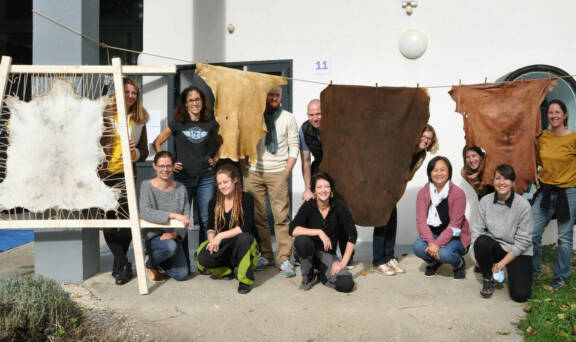
Within the CROYAN project, conservation is understood not as a purely technical operation, but as an integrated and collaborative process in which material science, historical research, hands-on practice and Indigenous knowledge are brought into dialogue (fig. 1). This approach is grounded in a simple premise: no single perspective is sufficient to understand the complexity of museum objects whose histories span production, use, circulation, and institutional life.

© musée du quai Branly - Jacques Chirac, photo Julien Brachhammer
Each object is therefore studied through a combination of detailed condition reports, high-definition photography, and a range of analytical techniques designed to identify materials, manufacturing processes, and current states of preservation. These investigations help reveal traces of use, transformation, and previous interventions. Far from being secondary details, such material traces are essential to reconstructing an object’s biography. They also complement knowledge transmitted through Indigenous oral histories, archival documentation and museum records, each contributing distinct yet interconnected forms of understanding.
Material Investigations and Scientific Analysis
A key objective of this integrated methodology is to ensure that conservation decisions are grounded in a comprehensive reading of the object. Identifying materials can reveal patterns of circulation and trade (fig. 2) ; tool marks provide evidence of making techniques; and signs of wear may indicate how an object was handled, used, and more generally valued. At the same time, traces resulting from previous conservation treatments offer insight into the institutional histories that have shaped the object’s current condition. Together, these elements inform both preventive strategies and remedial interventions, ensuring that conservation choices are context-sensitive and reversible whenever possible.

© musée du quai Branly - Jacques Chirac, photo Julien Brachhammer
Scientific analyses are conducted using a broad spectrum of non-invasive methods. The resulting data serve multiple purposes: they directly inform conservation treatments, contribute to broaden conservation science research, and support preventive conservation strategies such as exhibition planning and light exposure management.
Shared Perspectives and Indigenous Expertise
The specificity of the CRoyAN project lies not only in its analytical depth, but also in its collaborative framework. Central to the research process is the active participation of representatives from Native American Nations and cultural bearers. Their involvement is not limited to consultation but constitutes a genuine co-construction of knowledge. Through their oral histories, linguistic expertise and cultural knowledge, they contribute essential perspectives on the use, attribution, and meaning of objects (fig. 3).

© musée du quai Branly - Jacques Chirac, photo Julien Brachhammer
These exchanges also enable connections to be established between historical collections and contemporary cultural practices. In many cases, they open pathways for cultural and artistic revitalization, while also reshaping the ways in which museum professionals interpret and describe collections. This dialogue introduces new narratives that complement and sometimes challenge established scholarly frameworks, highlighting the inherently polyphonic nature of these collections.
Within this collaborative setting, conservation becomes a shared space of reflection and decision-making. Preventive and curative treatments are discussed collectively, with Native American partners actively contributing to decisions regarding levels of intervention, appropriate materials, and acceptable degrees of change. These discussions may concern highly practical issues—such as the stabilization of fragile elements or the choice of adhesives—but they also address broader questions, including the visibility of use marks, the treatment of soil or residues, or the preservation of earlier repairs that form part of an object’s history (fig. 4).

© musée du quai Branly - Jacques Chirac, photo Julien Brachhammer
Case studies within the project demonstrate how these multiple perspectives directly inform conservation outcomes. In some instances, minimal intervention is preferred to preserve traces of use considered culturally significant. In others, more interventionist treatments are undertaken to stabilize objects while maintaining their structural and aesthetic integrity. In all cases, decisions emerge from dialogue between conservators, scientists, curators, and Indigenous partners, ensuring that no single interpretive framework dominates the process.
This integrated approach also reshapes the very understanding of what constitutes “damage” or “alteration.” Wear marks, surface deposits, or structural modifications are no longer automatically treated as degradation to be removed, but are instead evaluated within broader cultural, historical, and material contexts. Such reassessments often lead to more nuanced conservation strategies that preserve the complexity of the object’s biography.
Rethinking Conservation as a Shared Practice
Ultimately, the CRoyAN project demonstrates that conservation is not only about stabilizing material objects, but also about sustaining relationships—with materials, with histories, and with the communities to whom these objects remain meaningful. The integration of scientific analysis and Indigenous knowledge does not replace existing methodologies; rather, it expands them, creating a more layered and reflexive practice.

© musée du quai Branly - Jacques Chirac, photo Julien Brachhammer
In this sense, an integrated and collaborative approach is not simply a methodological choice. It is a way of acknowledging that museum collections are living archives of multiple histories, and that their interpretation and preservation benefit from the coexistence of diverse forms of expertise (fig. 5). Through this process, conservation becomes both a scientific practice and a space of shared inquiry, where objects are understood not only through what they are made of, but also through the many relationships they continue to sustain.
Contributors

Clothilde CASTELLI
Specialist Conservator, Musée du quai Branly - Jacques Chirac

Elsa DEBIESSE
Head of Conservation, Musée du quai Branly - Jacques Chirac

Stéphanie ELARBI
Head of the Conservation Department, National Museum of Modern Art

Éléonore KISSEL
Head of Conservation and Restoration Unit, Musée du quai Branly - Jacques Chirac
Resources
Éléonore Kissel, Stéphanie Elarbi, Elsa Debiesse, Clothilde Castelli, Paz Núñez-Regueiro, Nikolaus Stolle and Céline Daher, “We will be known forever by the tracks we leave”, Conserva – VDR Beiträge zur Erhaltung von Kunst- und Kulturgut, 2024, 1, p. 18-33.
Related Topics